The Ultimate Gift of Adventure (DnD)
Affiliate Disclosure: As an Amazon Associate, we earn commissions from qualifying purchases made through links on this page. This comes at zero extra cost to you and helps support our hands-on review process.
If you have walked past a bookshop, scrolled through Netflix, or listened to a group of friends laughing raucously at a coffee shop lately, you have likely heard the whispers. It is a game of dragons, dungeons, dice, and high drama. For the uninitiated, Dungeons & Dragons (D&D) can seem like a dense, impenetrable fortress of maths and goblin lore. But peel back that hardback cover, and you will find something far more inviting: the world’s greatest collaborative storytelling engine.
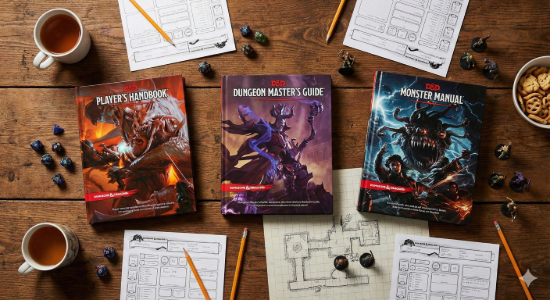 DnD Books
As someone who is always on the hunt for the perfect "Gift for Them", whether it’s for a creative teenager, a partner looking for a new hobby, or a family wanting to disconnect from screens, I cannot recommend D&D highly enough. But to truly unlock this world, you need the keys. Those keys come in the form of three beautifully illustrated hardback tomes: the Player's Handbook, the Dungeon Master's Guide, and the Monster Manual.
Today, we are going to deep-dive into exactly what this game is, why it has captured the world’s imagination, and review the essential books you need to get started.
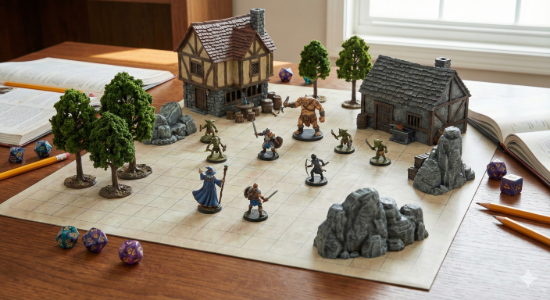 DnD Tabletop
The Core Concept: What Actually Is D&D?
At its heart, Dungeons & Dragons is a Tabletop Role-Playing Game (TTRPG). That is a bit of a mouthful, so let’s break it down.
Imagine reading your favourite fantasy novel, The Lord of the Rings or The Hobbit. Now, imagine that instead of passively reading what Frodo or Bilbo does next, you decide. You and your friends are the main characters. There is no script. There is no computer screen (unless you are playing online). There is just conversation, imagination, and the luck of the dice.
It is a cooperative game. Unlike Monopoly or Chess, you are not trying to beat the other players. There is no "winner" in the traditional sense. You win by telling a good story, surviving the perils of the dungeon, and having a brilliant time with your mates. You are a team of adventurers, a "party" working together to solve mysteries, defeat monsters, and explore imaginary worlds.
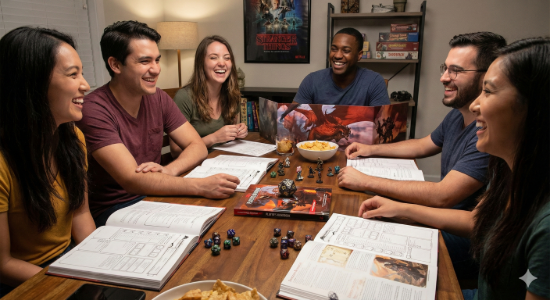 DnD In Person Game
How It Works: The Mechanics of Magic
While the game is fuelled by imagination, it is grounded in rules that stop it from becoming a chaotic shouting match of "I shot you!" versus "No you didn't!" The gameplay loop is actually quite elegant.
1. The Dungeon Master (DM)
One player takes on the role of the Dungeon Master. This is the game’s narrator, referee, and lead storyteller. The DM does not have a single character; they play everyone else. The shopkeeper selling you potions, the King asking for help, and the angry Red Dragon trying to toast you, the DM plays them all.
The DM describes the scene. For example:
- "You stand before the ancient, moss-covered door of the Sunless Citadel. The air smells of damp earth and old magic. A low growl echoes from the darkness within. What do you do?"*
2. The Player Characters (PCs)
The other players control a single hero each, known as a Player Character. You create this persona yourself using the rules in the books.
- Race/Lineage: Are you a stoic Dwarf, a graceful Elf, a clever Gnome, or a versatile Human?
- Class: This is your job within the group. Are you a Fighter (good with swords), a Wizard (wields arcane magic), a Rogue (sneaky and skilled), or perhaps a Cleric (healer and warrior)?
- Background: Who were you before the adventure? A soldier? A criminal? A noble?
3. The Gameplay Loop & The Dice
Once the DM describes the scene, the players describe their actions.
- Player: "I want to listen at the door to see if I can hear what made that growl."
- DM: "Okay, make a Perception check."
This is where the dice come in. D&D uses a set of polyhedral dice, but the star of the show is the d20 (a twenty-sided die).
1. Roll the d20. (Let’s say you roll a 12).
2. Add your Modifier. (Your character is wise, so you add +3 from your character sheet). Total = 15.
3. The DM Decides. The DM knows the "Difficulty Class" (DC) of the task. If 15 is high enough, you succeed.
- Success: "You hear the scraping of claws and the goblin language being whispered."
- Failure: "You hear nothing but your own breathing."
This simple loop, Describe, Decide, Roll, Narrate, is the engine that powers infinite adventures.
The Review: The Holy Trinity of Books
If you are looking to buy D&D as a gift, or to start yourself, you will hear about the "Core Rulebooks". While you can play with the free basic rules available online, the full experience requires these three books.
Here is what each book does and why it is essential.
1. The Player’s Handbook (PHB)
- The Essential Bible*
If you only buy one book, make it this one. The Player’s Handbook is the beating heart of the game. It is the user manual for every player.
- What is inside?*
- Step-by-Step Character Creation: It guides you through building your hero, from choosing your species (Elf, Orc, Tiefling, etc.) to picking your class (Bard, Paladin, Monk, etc.).
- The Rules of Play: It explains how combat works, how exploration works, and how social interactions are resolved.
- Equipment and Magic: It contains long lists of weapons, armour, and adventuring gear. Crucially, the back half of the book is a massive grimoire of spells.
- Our Verdict:* It is beautifully laid out and extremely comprehensive. It is the absolute must-have for anyone sitting at the table.
2. The Dungeon Master’s Guide (DMG)
- The Referee’s Whistle & World Builder’s Toolkit*
This book is specifically for the person running the game. If you are a player, you can skip this. If you are the DM, this is your secret weapon.
- What is inside?*
- Running the Game: It offers advice on how to handle table disputes, how to adjudicate rules on the fly, and how to pace a session so it is exciting.
- World Building: This is the creative juice. It teaches you how to create your own pantheon of gods, how to map out a dungeon, and how to create a compelling villain.
- Magic Items: This is the fun part! The DMG is full of treasure. Magic swords, flying carpets, and potions of invisibility are all listed here for you to hand out to your players as rewards.
- Our Verdict:* The guide provides excellent advice and world-building resources. It feels like a mentor guiding you through the process of creating a story.
3. The Monster Manual (MM)
A hero is defined by the villains they defeat. The Monster Manual is a bestiary containing hundreds of creatures to populate your world.
- What is inside?*
- Stat Blocks: Every monster needs numbers. How hard is a dragon’s scale? How much damage does a giant’s club do? It is all here.
- Lore and Ecology: It doesn’t just give you numbers; it tells you how these creatures live. You learn that Hobgoblins are disciplined soldiers, while Goblins are chaotic scavengers.
- Art: The illustrations are terrifying and inspiring in equal measure. Showing your players a picture of the Beholder they are fighting is a great moment of tension!
- Our Verdict:* Essential for the DM. You cannot run a combat encounter without knowing what the bad guys can do.
It’s Not Just Knights and Dragons
One of the biggest misconceptions about D&D is that it is strictly "High Fantasy", medieval Europe with magic. While that is the classic flavour, the D&D rules system is incredibly versatile.
- Sci-Fi & Space Opera: You can play a campaign set on spell-jamming ships traversing the cosmos.
- Gothic Horror: Venture into the mists of Ravenloft, battling vampires and werewolves in a Victorian-esque setting.
- Post-Apocalyptic: Explore the ruins of fallen civilisations where magic has gone wild.
- Mythological: Play in a world inspired by Ancient Greece or Norse legends.
The "flavour" of the game is entirely up to the table. Whether you want a serious, gritty, Game of Thrones-style political drama or a light-hearted romp that feels more like Monty Python, D&D can support it.
Who Can Play? (Spoiler: Everyone)
Dungeons & Dragons shed its basement-dwelling stereotype decades ago. Today, it is a global phenomenon played by millions.
- Families: I cannot recommend D&D enough for family game nights. It pulls children away from screens and forces them to use critical thinking, maths, and empathy.
- Friend Groups: It is a fantastic reason to get the gang together regularly. It is "scheduled socialising" with a purpose.
The Digital Revolution: D&D Beyond & VTTs
You don’t need to be in the same room anymore. VTT gaming allows you to play online.
- D&D Beyond: This is the official digital toolset. It allows you to build characters in minutes and look up rules instantly.
- Maps & VTTs: Platforms like Roll20, Foundry, or the new 3D Project Sigil allow you to move digital tokens on a virtual map while video-chatting with friends globally.
What It Gives You: The Hidden Benefits
Why do we spend four hours pretending to be elves? Because the returns are genuine and tangible.
- 1. Unrivalled Social Connection:* You are building a shared memory. Years later, you will say to your friend, "Remember when you rolled that natural 20 and jumped onto the dragon’s back?"
- 2. Creativity & Problem Solving:* D&D is essentially a series of logic puzzles wrapped in a story. It trains your brain to think laterally.
- 3. Emotional & Social Skills:* Role-playing is an empathy gym. It is also a safe space to practise public speaking and assertiveness.
- 4. A Break from Reality:* For a few hours, you are not worrying about bills or the news. You are worrying about saving the village from a necromancer.
Getting Started: The Toolkit
You do not need to spend a fortune to start. You really only need three things: Imagination, Friends, and Dice.
However, if you want to run the game properly, investing in the Core Rulebooks we reviewed above is the best path.
- Top Tip:* For beginners, I highly recommend a Starter Set adventure. They hold your hand and teach you the ropes as you play.